
Normally, kharif sowing of vegetable seeds starts during the first week of May across the country. Farmers start preparing their fields to make them suitable for kharif sowing during the second fortnight of April. Now, however, faced with the lockdown, farmers are in a hurry to clear their fields of rabi crop and prepare for kharif planting. With a normal monsoon forecast this year, they are doing all they can to take advantage of pre-monsoon showers.

India's leading commodity exchange, National Commodity and Derivatives Exchange (NCDEX), and private weather forecasting company Skymet took a significant step towards launching the country's first tradeable weather index on Monday (August 14) by entering into an agreement to deepen their understanding of the impact that weather has on agricultural commodities. The memorandum of understanding (MoU) between NCDEX and Skymet is a profound step in the direction of linking farmers with the weather in a scientific way, according to an official statement. Sources indicate that NCDEX and Skymet will conduct workshops and seminars across the country to educate farmers about how they can scientifically use weather forecasts to hedge risks.

A few days back, Atul Ganatra, president of the Cotton Association of India, presented a grim scenario of the crop's prospects in the 2024-25 season that starts in October. Addressing the association's annual general meeting, Ganatra said the area under the crop could go down by at least 10 per cent in the coming season due to falling yields and realisation, leading to farmers losing interest. The fear of a decline in acreage comes against the backdrop of India's cotton production probably falling to its lowest in a decade, according to estimates.

Apart from the human body, human food will bear direct repercussions. From staples such as wheat, to coffee, dairy, and even the great Hilsa face the threat of reduced supply due to the extreme heat.
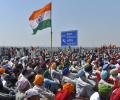
Farmer leaders on Saturday said the protesting unions stand firm on their demand of a complete repeal of the three agri laws and asserted that they are ready for talks with the government, but that should be held without any condition.

Karnataka, Andhra Pradesh, Tamil Nadu, Rajasthan, Maharashtra, Bihar, Uttar Pradesh, Madhya Pradesh, and Gujarat account for 85 per cent of India's maize production.

Tomar said the union leaders kept insisting on repeal of the three farm laws, but the government side tried to explain them the benefits of the Acts and sought to know specific problems faced by the farmers.

'Agriculture has been given the wrong kind of attention.' 'More innovations are needed for the sector to be successful,' says Devi Murthy of Kamal Kisan.

For the Mizo people, tribal and family identity are important. But so are jobs, farmers' access to markets, roads, and health facilities for a young population where drugs are a big affliction.

'I found it unbelievable that L&T said 45,000 jobs were waiting to be filled because of unavailability of suitable skillsets.' 'So, when the Opposition sweepingly says there are no jobs, I'm sorry... I'm not saying it's raining jobs, but there are jobs. The (skill) gap has to be bridged.'

'We want to make sustainability affordable.' 'We tell everyone, don't just recycle, Craste it!'

Rice exporters have requested the Centre for a flat export duty of $80 per tonne for parboiled rice instead of the current 20 per cent duty to smoothen trade, a top official of the rice exporters' umbrella body said on Sunday. The Indian Rice Exporters Federation (IREF) has also requested the government to reconsider its export ban on white rice which was imposed in July and reduction in the minimum export price for basmati rice to $850 per tonne to prevent negative impacts on both export volumes and farmers. On Friday, the government had extended the 20 per cent duty on parboiled rice exports until March 24.

Sticking to their key demand of the repeal of three farm laws to end their protest, farmer leaders on Friday told the government their 'ghar wapsi' can happen only after 'law wapsi' but the Centre insisted talks must be limited to contentious clauses and ruled out a complete withdrawal of Acts.
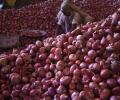
Onion prices are likely to start shooting up in the retail market towards the end of August before going up further to around Rs 60-70 per kg next month due to tightened supplies, a report said on Friday. However, the prices will remain below the highs of 2020, it said. "The supply-demand imbalance is expected to reflect in onion prices towards end-August. "As per our ground interactions, prices are expected to show significant increase from early September in the retail market, reaching up to Rs 60-70 per kg during the lean patch.
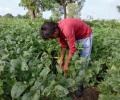
There has been some improvement in prices of oilseed and gram after the central government increased their import duties
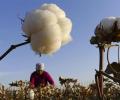
The ongoing Gujarat cotton farmers' agitation demanding better minimum support price took a new turn on Wednesday, after a 21-year-old farmer died due to self-immolation at the district's Vinchhiya marketing yard, because of not getting a good price for his cotton.

Experts said many of the programmes started in the last one year have been dogged by poor implementation, something which the state seriously needs to answer as it faces a tough electoral battle in the months ahead.

The ten trade unions are National Trades Union Congress, All India Trade Union Congress, Hind Mazdoor Sabha, Centre of Indian Trade Unions, All India United Trade Union Centre, Trade Union Coordination Centre, Self Employed Women's Association, All India Central Council of Trade Unions, Labour Progressive Federation and United Trade Union Congress.

On the hike in fuel prices, she accused the government of profiteering and said it is turning a disaster into an opportunity to fill its coffers. She also alleged that the government is breaking the back of the poor, the farmers, and the middle class due to its 'insensitivity'.
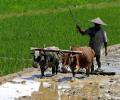
States need to create alternative marketing structures for farm produce since middlemen also provide vital services that are otherwise unavailable to the farmer.

According to the ministry's statement, Tomar thanked the BKU (Kisan) leaders for coming out in support of the Farm Acts and said these laws have been welcomed in various states across the country.

Regardless of how the stalemate ends, the government needs to learn that regardless of its parliamentary strength it cannot take people for granted. A little bit of humility would do it a lot of good, recommends Virendra Kapoor.
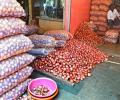
With auctions unable to proceed, the median onion price declined 17 per cent or Rs 6 a kg to trade at Rs 30 a kg on Monday, with arrivals of around 500 tonnes.
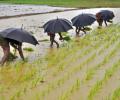
The high-level panel also asked the government to work towards re-orienting subsidies in a targeted manner from the crop sector to the non-crop sector and redesign the electronic National Agriculture Market.
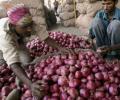
In the retail markets, fresh onion is sold between Rs 10 and Rs 12 a kg. Now, farmers have to sell onion at a loss of Rs 2-3 per kg if transport cost is included.

Farmer leader Joginder Singh Ugrahan said told reporters after the meeting that the unions urged the government to repeal the three laws, but the Centre was unwilling to do so. "We decided to meet again on January 19 at 12 pm," he said.
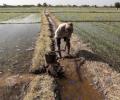
Despite the growing clamour from the central government on India turning digital, and banks requesting direct bank account transfer, the state government decided to hand over cheques to the farmers, which can be immediately converted into cash.

The interim Budget proposals that will be presented on February 1 in the backdrop of the general elections scheduled in April/May 2024 are likely to have a hint of populism, believe analysts, but are unlikely to derail the government from its path of fiscal prudence.
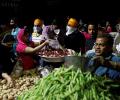
The government of Maharashtra decided to shut operations at APMC Vashi mandi between May 11 and 17 after confirmed cases of Covid-19 surpassed 80 in the APMC and over 450 across Navi Mumbai, where the mandi is located.
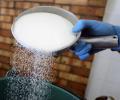
The last few years have been uncharacteristically good for the Indian sugar sector for a variety of reasons. While on the one hand, the weather supported good crop production; on the other hand, the programme to blend ethanol with petrol took off in a big way. The long-pending problem of burgeoning sugarcane arrears almost came down to nil and exports boomed to record highs.

'If the BJP thinks they can suppress the farmers' movement by opening fire, they are wrong.' 'It will create a boomerang effect which will be very difficult to manage.'

It also pledged to give interest free crop loan of up to Rs 3 lakh to farmers.
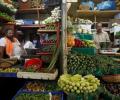
While rising food inflation is a matter of grave concern for a significant chunk of the population and for policy makers as well, it marks a turnaround in the fortunes of the farmer, reports Sanjeeb Mukherjee.

Finance Minister Nirmala Sitharaman on Thursday announced a Rs 11.11 lakh crore spending on infrastructure and vowed to continue reforms as she resisted resorting to populist measures in Modi government's last Budget before general elections, instead choosing to stay on the path of cutting deficit while bolstering measures for focus groups.

Some eyewitnesses alleged that the victims suffered bullet wounds but district authorities denied that there was any firing by police

The best-case scenario is that the BJP will top out at around 50 seats in UP -- a drop of 12 from the 62 it had won in 2019. Taken in tandem with Maharashtra and Karnataka, this is what is likely to put paid to the BJP's ambitions of a third term for Modi, argues Prem Panicker.

'Modi came out with this huge announcement that he has given a historic price rise to farmers.' 'It was actually a fake price. He did not give the price mentioned in the BJP's election manifesto.' 'So, Modi gave an incomplete price rise and publicised it as if he has completed his job.' ''This government has surely proved that it does not care about farmers in any way.'

Beyond the macro data, there has been little enquiry into the profile of the indebted farmer households, says Shailesh Dobhal.
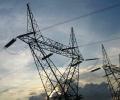
From Jammu and Kashmir to Andhra Pradesh, consumers are facing power cuts ranging from 2 hours to 8 hours.

Tourism is badly affected. Entire apple orchards have been washed away. 2 million people are threatened with loss of livelihood.
 © 2026 Rediff.com - Advertise with us - Disclaimer - Privacy Policy - Sitemap - Feedback - About us - Terms of use - Grievances